What has to be true before a capital plan can be defended
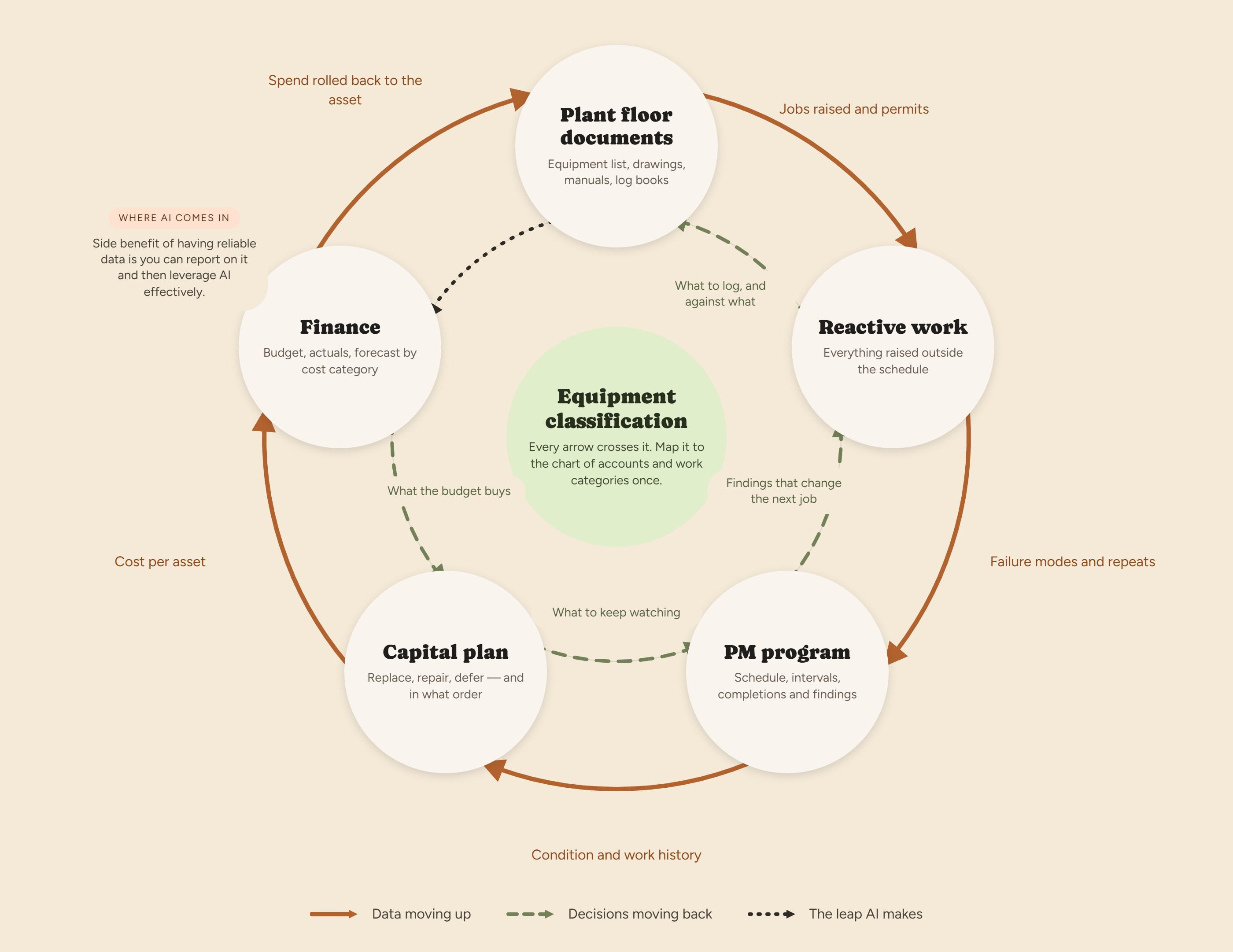
What has to be true before a capital plan can be defended
Most plants can tell you which machine to replace. Far fewer can show why, with records that trace back to what that machine actually costs them to run. That gap is what turns a capital plan into a list of opinions with dollar figures attached - and closing it has an order.
The boiler everyone wanted to replace
A post-war Cleaver-Brooks firetube boiler. Everyone agreed it was old, inefficient and needed replacing, and they were right that it was old. Tracing the system said something different. The vacuum and condensate recovery systems were not working effectively, and the burner had not been tuned properly for some time. Fixing those was drastically cheaper than replacing the boiler, and it brought the fuel consumption down. The replacement was deferred to a point where it made more sense.
Nobody in that building was wrong about the boiler's age. They were wrong about what the age was costing them, because what it was costing them sat upstream and downstream of the boiler and nobody had traced it. A capital plan assembled from what everyone already agrees about the equipment is a plan assembled from the loudest assumption in the building.
What you are trying find
Six things, and what is missing from them matters more than what is in them.
- Work order history. Everything that was raised, however it was raised — including the jobs that started as a conversation in the hallway.
- PM history. What was actually done and signed off, not what the schedule says should have happened.
- The PM schedule. The intervals, and where each interval came from.
- The equipment list. Everything carrying a tag number, and the equipment that has never had one.
- Drawings, manuals and training material. As-builts where they exist, and the date the drawings were last touched.
- A list of critical and compliance items. What has to be inspected, by whom, and on what interval.
If any of these are missing, those are the first to flag. Without them the information connection is broken and no capital plan, or forecast, can be defended properly.
Not all equipment needs a PM. The equipment that matters does — the equipment that can shut your production down, or affect safety, or affect efficiency. Equipment with no PM is rarely a decision anyone made. It is equipment that arrived after the schedule was written, or that used to belong to a contractor, or that was added to the process without being added to the list.
This is also what decides whether maintenance software earns its keep. The software is not the problem, a well-configured system is one of the most useful things in a maintenance department. But it is configured against the records you already hold, and it inherits whatever is wrong with them. Set up against a complete equipment list, it compounds. Set up against a list with holes in it, it makes the holes harder to see.
Start with the people, not the data
Looking at the data is not enough to start. Before any export, sit with the shift leads, the operations manager and whoever holds the engineering records - and with stores and safety, who usually get missed. Ask what they use to run the day, where it lives, who puts it there and when. This is the first gateway: identify what information is important, where it is collected, by who, when, and how that information is used today.
What comes back is spreadsheets, software, filing cabinets, files on SharePoint, notebooks. That list is the real system of record, and it rarely matches the one on the org chart.
It is also where the disagreements surface. Operations, maintenance and engineering will each name a different asset as the one costing the most, and none of them is wrong from where they sit. Write down all three.
Then walk the plant
Walk the process from raw material in to finished product out. At each step ask what role the equipment plays in the process rather than what the equipment is. That question is how the critical assets fall out, and criticality to the process and safety is the only definition that survives a finance question about why this pump and not that one.
What to look for:
- Patch jobs put in to keep the system running, and bypasses left open.
- The parts of the process that fail most - ask directly, the answer comes quickly.
- The readings that carry the most value in understanding the state of the system - steam pressure, condensate flow coming back, RPM or feed rate on a conveyor. Find out who looks at it and what they do when it moves.
- Effluent, emissions, water treatment, and the processing steps that are actively measured - then ask what has changed in the last few years.
How long the walk takes is a function of the plant, not of the method.
The work nobody wrote down
The worst kind of reactive work is the work that is not logged. One of the heat recovery exchangers kept plugging up. It ran like that for months, and while it was plugged the plant burned more fuel to pre-heat the water. None of that work was recorded. So there was no chance to change the PM to do it more regularly, and no case to put a filtering mechanism upstream to stop it clogging. Hidden reactive work is lost opportunity - if you don't know, you cannot act.
You cannot pull that work out of the data, because it is not in there. It comes out of the interviews and the walk, enough of it to get a sense of how much is not being logged. Not all work will be logged, and that is fine. The rest of it turns up in the log books, in the projects that never got ingested into the maintenance system, and in the drawings that were never updated afterwards.
Compliance work done ad hoc is the same failure with a sharper edge. It is invisible twice: not a cost, so the equipment looks cheaper to run than it is, and not evidence, so it cannot be produced when someone asks for it.
Where the classification has to reach
Everything is a control system: input, transformation, output, feedback. Data and business process are no exception, and the feedback is the part that gets left out.
The connection that carries this one is classification. Reactive work and PMs classified against the equipment classification, and the equipment classification mapped to the finance cost categories. Nobody has to change how they categorize anything — maintenance keeps its structure, finance keeps its chart of accounts. The two only have to be mapped to each other.
Once they are, you can put actuals, budget and forecast side by side against the same categories and ask whether they agree. When they do not agree, there is a disconnect somewhere between the floor and the ledger, and finding it is the work. Without that comparison you are running open loop: maintenance spends, finance reports, and nothing tells either of them whether the money went where the plan said it would.
What you can actually defend
The test is narrow. Reactive work plus PM work, with every record traceable to a date and time, a specific piece of equipment, and what production was doing at the time. If a record traces on all three, it can carry a number in a capital request. If it does not, it is an anecdote.
Most of what comes out of this is unglamorous — log the work properly, fill in the gaps, connect records that already exist. That is the point. The expensive version of this problem is the one where you replace a boiler that did not need replacing.
If you are building a capital plan and the six documents above are not all in one place, that is the conversation to have. Book a call
Common questions
What records do you need to defend a capital plan?
Six: work order history, PM history, the PM schedule, the equipment list, drawings and manuals, and a list of critical and compliance items. What is missing from that set matters more than what is in it. If any of the six cannot be produced, that absence is the first finding, and the plan built on top of it cannot be defended.
How do you justify replacing equipment with maintenance data?
With failure history and condition, both traceable to the specific asset. A record that traces to a date and time, a piece of equipment, and what production was doing can carry a number in a capital request. A record that does not is an anecdote. Age on its own justifies nothing — it is often the cheapest thing wrong with a machine.
How do you find maintenance work that was never logged?
Not from the data, because it is not in there. It comes out of the interviews and the walk, which give you a sense of how much work is going unrecorded. The rest turns up in log books, in projects that never got ingested into the maintenance system, and in drawings that were never updated after the work was done.
How do you map maintenance costs to finance categories?
Classify reactive work and PMs against the equipment classification, then map that classification to the finance cost categories. Nobody changes how they categorize anything — maintenance keeps its structure and finance keeps its chart of accounts. Once the two are mapped, actuals, budget and forecast can be compared on the same basis.
What should be on an equipment list?
Everything that matters, with enough information held against each asset to build a PM from it. Equipment that matters is equipment that can shut production down, or affect safety, or affect efficiency. Equipment missing from the list is rarely a decision anyone made — it arrived after the schedule was written, or belonged to a contractor.**
Recognise any of this in your own plant?
Twenty minutes, technical, no deck — your equipment, how the work gets recorded, and where the chain breaks.
Book a call